By LAURAN NEERGAARD AP Medical Writer
WASHINGTON (AP) — “Exercise your brain,” experts advise people hoping to stave off dementia. But how? Stretching your brain might be the better description.
Do a crossword puzzle a day and you may just get good at crosswords. Instead, research increasingly shows that a variety of habits and hobbies are like a cognitive workout, building knowledge and skills that may beef up parts of the brain as we get older.
One recent study linked a lower risk of Alzheimer’s disease and cognitive decline to lifelong learning, meaning intellectually stimulating experiences — reading and writing, learning another language, playing chess, solving puzzles, going to museums — from childhood into retirement.
“They kind of like stretch your brain and your thinking. You’re using your different cognitive systems,” explained neuropsychologist Andrea Zammit of Rush University Medical Center in Chicago, who led that study.
If you didn’t embrace what Zammit calls cognitively enriching activities early in life, it’s not too late to get started. Middle age offers an important window for protecting brain health and scientists are examining a wide range of possible ways to stay sharp, from taking up music to birdwatching and brain-training games.
“It’s not just one activity. It’s more about finding meaningful activities that you might be passionate about,” Zammit said — and sticking with them rather than dabbling.
Physical health is critical to brain health, too. That’s why experts also recommend the work-up-a-sweat kind of exercise as well as controlling blood pressure, good sleep, even later-in-life vaccination.
There’s no magic recipe to prevent either dementia or the normal cognitive decline of aging, cautioned Dr. Ronald Petersen, an Alzheimer’s specialist at the Mayo Clinic. But lifestyle changes offer a chance to “slow down the arc of deterioration,” he said.
Building cognitive reserve may buffer an aging brain
Zammit’s study on lifelong learning study enrolled nearly 2,000 older adults, ranging from age 53 to 100, who started out dementia-free and were tracked for eight years. Researchers quizzed them about educational and other cognitively stimulating activities in their youth, middle and older ages, and administered a battery of neurologic tests.
Some eventually were diagnosed with Alzheimer’s disease — but it struck five years later in those with the highest amount of lifelong learning compared to those with the least amount, Zammit’s team reported in the journal Neurology. And staying more mentally active in middle age and beyond was linked to a slower rate of cognitive decline.
More interesting, Zammit said, were autopsy findings from 948 participants who died during the study: Even when their brains harbored Alzheimer’s hallmarks, the more cognitively “enriched” people had better memory and thinking skills and a slower decline before their death.
That’s what scientists call cognitive reserve. It means learning strengthened neural connections in various regions, helping the brain to be more resilient, able to work around damage from aging or disease at least for a while.
More clues that exercising the brain matters
The Rush study can’t prove cause-and-effect — it shows an association between cognitive stimulation and dementia risk. Other studies offer similar clues, such as those linking brain health to playing a musical instrument.
Another study hinted that brain “speed training” — using an online program that requires spotting images as a screen flashes increasing distractions — also may help. A study funded by the National Institutes of Health now is examining if there’s benefit to long-term computerized exercises that aim to improve attention and reaction time.
That brain processing speed affects how we multitask or drive, said Jessica Langbaum of the Banner Alzheimer’s Institute, who isn’t involved with the brain training research. For now, she advises choosing activities that help you think on your feet — maybe joining a book club to combine solo reading with discussion and social connection.
Here are other steps to lower dementia risk
Lots of chronic health problems that strike in middle age can increase the risk of later-in-life Alzheimer’s or other forms of dementia. For example, high blood pressure damages blood vessels, which is bad for the heart and reduces blood flow to the brain. Poorly controlled diabetes can spur damaging inflammation in the brain.
That means key recommendations for heart health — get regular exercise, eat lots of fruits and vegetables, avoid obesity and control diabetes, high blood pressure and high cholesterol — also are good for brain health.
A bonus step: Get vaccinated against shingles. It not only prevents that incredibly painful rash but growing research shows the vaccinated have a lower risk of developing dementia.
___
The Associated Press Health and Science Department receives support from the Howard Hughes Medical Institute’s Department of Science Education and the Robert Wood Johnson Foundation. The AP is solely responsible for all content.
News
Challenging your brain helps keep it healthy. Here’s how to do it
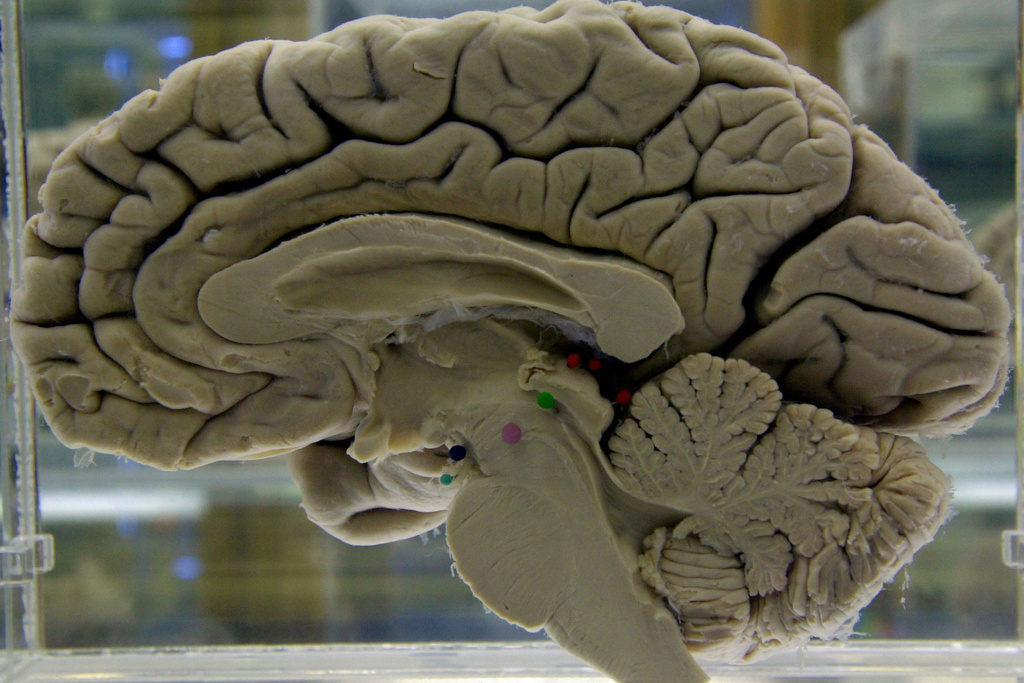
FILE - A section of a preserved human brain on display at the Museum of Neuroanatomy at the University at Buffalo, in Buffalo, N.Y., on Tuesday, Oct. 7, 2003. (AP Photo/David Duprey, File) Photo: Associated Press